
 PL
 DE
 CS
 SK
 SV
 HU
 BG
 RO
 UK
 FR
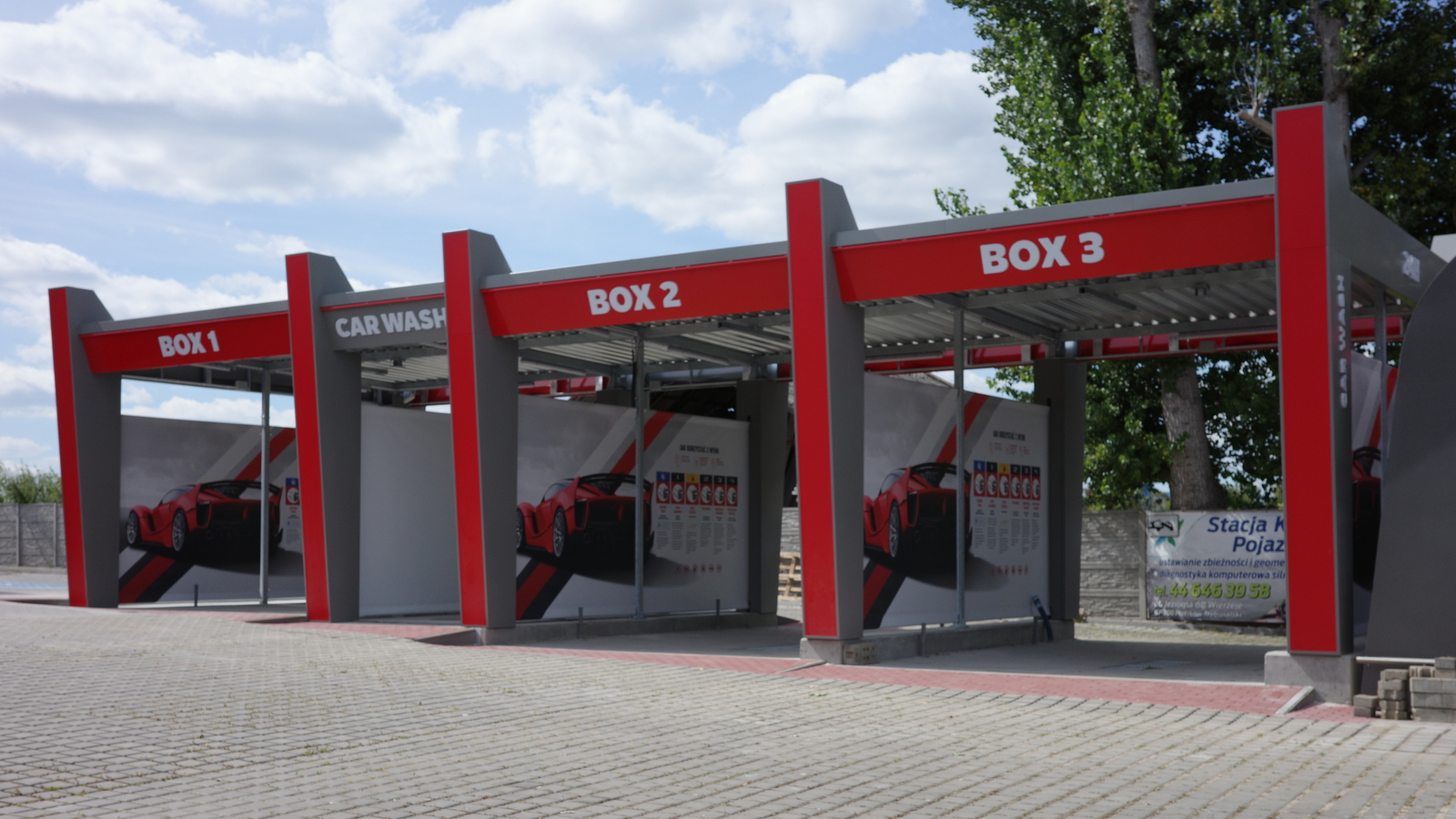
How much does it cost to open a touchless car wash? Cost components and pitfalls
A touchless car wash can be a great business, but only if you approach it as an investment project rather than “putting up a few bays”. The most common questions are about the cost of opening a touchless car wash and how much it costs to start a touchless car wash – and they are good questions, because in this industry the most expensive things are often not the equipment itself, but mistakes in location, badly calculated infrastructure and corrections after poorly planned construction.
Below is a concrete, practical guide: what makes up the start-up costs, what the fixed costs are, what affects revenue, where investors lose the most and how to approach choosing a partner (so that you don’t overpay – but also don’t “save” yourself into trouble).
Before you calculate the costs – what car wash model are you opening?
The final cost of opening a touchless car wash depends on what exactly you are building. Even “the same” car wash can cost completely different amounts depending on the decisions:
- number of bays (e.g. 2, 3, 4, 6),
- whether you build an “elaborate” canopy (design + extra lighting + screens) or a simple version,
- whether you add straight away: vacuums, upholstery cleaning, a compressor, dispensers, a change machine, a mat station,
- whether you put the car wash next to an existing business (e.g. a fuel station / supermarket) or as a stand-alone site,
- what standard of finish and visibility you choose (branding, parapets, signage system, LED lighting).
In practice, how much it costs to start a touchless car wash is always the sum of modules. The better you describe them at the start, the fewer “surprises” during the works.
What makes up CAPEX? (i.e. start-up costs)
Below is a list of items that really build up the cost of opening a touchless car wash. It is a good framework for talks with contractors and for comparing offers.
Plot and site preparation
- groundworks (excavation, stabilisation, soil replacement),
- drainage and falls (so that the forecourt does not stand in water and freeze in winter),
- access/entrance, kerbs, traffic layout on the forecourt.
This is where the biggest differences can “pop up”. Two identical car washes can cost different amounts just because one stands on simple ground and the other needs drainage and reinforcement.
Foundations, floors, service channels
- slabs and foundations for the structure,
- bay floors (resistance to chemicals and loads),
- channels, manholes, installation routes.
These are elements you cannot see in project photos, yet they determine trouble-free operation.
Utilities and connections (water, electricity, sewerage)
In practice, connections can shift the schedule and costs more than the car wash itself:
- connection capacity and switchboard,
- water installations and protections,
- discharge of process wastewater (local requirements),
- often: buffer tanks, filtration elements, recycling solutions (if planned).
If someone calculates how much it costs to start a touchless car wash based only on the “price of the equipment”, this is usually where a painful clash with reality happens.
Car wash technology: equipment and accessories
- units, pumps, chemical dosing system,
- wash programmes, controls,
- payment systems (coins/notes/card),
- bay accessories (lances, booms, hoses, holders, protections).
It is easy to fall into the trap of “I’ll take a cheaper set” and then pay in service and downtime. In a car wash, reliable operation is what counts – because every hour of downtime is real lost revenue.
Structure, enclosures and site aesthetics
This topic is often treated as an add-on, but in practice it affects:
- durability (resistance to weather and chemicals),
- safety and ergonomics,
- visibility and how customers perceive the site.
This part includes steel structures, bay enclosures, parapets, screens, panels and finishing elements.
Visibility, signage, lighting
This is what “sells” the car wash. You can have great technology, but if drivers don’t notice it or don’t understand how to use it, they won’t come back.
In practice this includes:
- clear programme boards,
- an entry/exit directional system,
- LED lighting of the bays and forecourt,
- visual identity elements.
And this is exactly where a partner such as Aspera sensibly comes in – specifically: it is not about “prettier”, but about the fact that a well-planned enclosure and signage reduce chaos on the forecourt, increase ease of use and raise conversion (i.e. more washes from the same traffic).
OPEX operating costs – which investors forget about
When people talk about the cost of opening a touchless car wash, many think only of construction. Then comes the surprise, because monthly costs “eat” the margin.
The most common fixed and variable costs:
- electricity (especially in winter and with strong lighting),
- water and wastewater,
- chemicals (and their consistent quality),
- service and consumable parts,
- cleaning and upkeep,
- snow clearing/de-icing, seasonal works,
- monitoring/security (depending on the location).
Pro tip: before you calculate how much it costs to start a touchless car wash, also work out “how many washes per day I need” to cover fixed costs and repay the financing. This is often more sobering than any brochure.
What really affects revenue and return on investment?
Revenue is affected by three things:
- Traffic and ease of entry
A car wash may be next to a busy road, but if the entrance is awkward or unclear, people won’t turn in. - Customer experience in the bay
Is everything intuitive? Are the programmes clearly described? Is it bright at night? Is there room to stop and drive off? - Site standard and “credibility”
In practice customers judge a car wash in 3 seconds: does it look clean, safe and modern? It doesn’t have to be high-end, but it must be consistent and well kept.
This is where structural elements, enclosures, lighting and signage do the job. And this is why Aspera can be a sensible partner: it designs the canopy structure and the site branding together – so the site can be planned from the start in a way that avoids corrections after six months, when problems with visibility, traffic guidance or durability of elements come to light.
Typical pitfalls that push up the cost of the investment
If you want to keep the cost of opening a touchless car wash under control, avoid these mistakes:
- Buying a plot without checking utilities and wastewater discharge conditions
- Underestimating groundworks and drainage
- “Adding” elements during the works (an extra bay, vacuums, a change of layout)
- Leaving signage and lighting until the very end
- A contractor’s offer without a clear scope: what is included and what is “on the investor’s side”
- No plan for servicing and maintaining the site (and then downtime)
How to approach choosing a partner (using Aspera as an example)
If you are considering working with a partner such as Aspera, the fairest way is to look at it through three benefits that can be verified:
1) One coordination instead of several subcontractors
When different companies do the structure, enclosures, signage and lighting, it often ends in scope conflicts, corrections and delays. A partner who coordinates these elements together usually reduces the risk of “mismatches” (e.g. missing ducts, power supply, fixings or places for identity elements).
2) A “function + durability + visibility” approach
In a touchless car wash it is not about looking nice in a photo. It is about elements not deteriorating from chemicals and weather, and the site being clear to drivers. Aspera has project experience here: enclosures, structures, advertising elements and lighting can be designed as a whole.
3) Service and modernisation
Realistically, after 12–24 months most sites improve something anyway – adding lighting, completing signage, changing the information layout, replacing elements exposed to wear. A partner with experience in modernisation makes it possible to do this efficiently, without a revolution.
To avoid sugar-coating: it is worth explicitly asking the partner for a scope table, material standards, warranty terms, deadlines and a clear list of items on the investor’s side. This is the best filter for serious contractors.
A simple cost “calculator” – how to calculate start-up costs
If you want to quickly estimate how much it costs to start a touchless car wash, calculate the costs in 5 baskets:
- Plot + groundworks + forecourt
- Foundations + installations + connections
- Car wash technology + payments
- Structure + enclosures
- Signage + lighting + customer guidance elements
Finally, add a reserve (it is usually sensible to have a buffer for unforeseen works and approvals), because real life on a construction site almost always adds “small things” that are not small at all.
Summary
The cost of opening a touchless car wash and how much it costs to start a touchless car wash do not come down to the price of the equipment. The biggest differences are made by plot conditions, connections, drainage, foundation quality and whether the site is clear and convenient for customers. If you want to approach the topic sensibly, calculate the budget in modules, work out the operating costs and choose a partner who can combine technology with the function of the site. Aspera can be a good choice as a contractor for structural elements, enclosures, signage and lighting – especially when you want a consistent project without friction between teams – but it is still worth firmly verifying the scope, materials and service.
Aspera manufactures car wash structures and enclosures, wash bay partitions, structure lighting and site signage – including installation. Washing technology, payment systems and installations are supplied by the investor’s specialised suppliers. Planning a new investment, a modernisation or a rebranding? Let’s talk about your site.